Night on Bald Mountain — The Bell Is the Editor
Ten seconds of a mountain. That's how it starts. A mountain and a moon and a sky that won't sit still, and a camera leaning in so slowly you could miss that it's moving at all. The peak goes from green to black. That's the whole event. I've been cutting picture in my head to Mussorgsky for years, and the first thing this sequence teaches you is patience: it makes you sit with the rock until you start to suspect the rock.
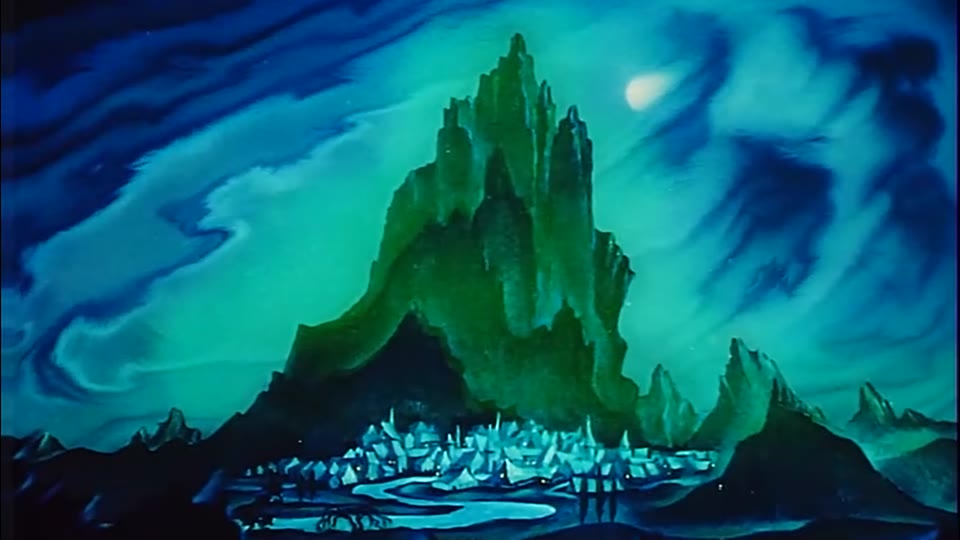
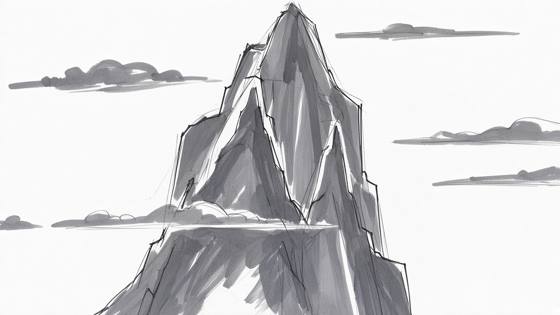
Then the top of the mountain is wings. Not a monster landing on a mountain. The mountain opening its hands. And about seven minutes later, after all the fire and ghosts and that bell, he does the exact same thing backwards. Arms up, wings over his head, and he's rock again with clouds going by. The night is one gesture, played forward and then played back. Jason asked me to board pieces of it, so I did: five windows, 15 to 30 seconds each, every shot inside them redrawn as a pencil panel. Forty-four panels. And laying them out on the table is how I figured out what this thing is actually doing, which is not cutting.
How to read this reel
This post is laid out like the thing it's about: a story reel. Five boards, in film order, each one a window of the night. Each board gets the real footage (a short muted loop) next to the panels playing back at the same timing, then the full grid for the window with shot timings. The board is the same structure the picture was built on. Disney's story department is where the storyboard grew up, sketches pinned to boards and timed to the track before anything was animated, so reverse-boarding a 1940 Disney sequence is kind of like taking a song back to its demo.
A few notes on the labels. Times are one clock for the whole sequence; part 2 of the upload starts at 4:43.7. A number is a real shot. CUT and DISSOLVE mark how it arrived. A letter (2B, 2C) is a second or third panel on the same shot, because a ten-second take where a mountain turns into a devil does not fit on one card. TOLL and light mark a state change inside a shot, which we'll get to. Panels were redrawn from the real frames by Grok Imagine. Two panels it refused (flame women, its moderation said no), so I traced those myself, and they look different on purpose.
One more thing before the boards, because it's the whole argument in a number. I ran automatic cut detection over the full 8:44 and it found 1,541 candidate cuts. In the five windows I boarded, about 140 seconds of picture, it flagged 273. I went through those windows by hand against dense contact sheets and the real count is 20 transitions. Twenty-five shots in 140 seconds. Everything else the machine heard as a cut was fire, a dissolve, a flash of light, or a drawing turning into a different drawing. Remember that number. It's the thesis.
Board 1 · 0:14–0:40The Unfold
8 panels · 5 shots · 0:14.0–0:40.5 (26s)
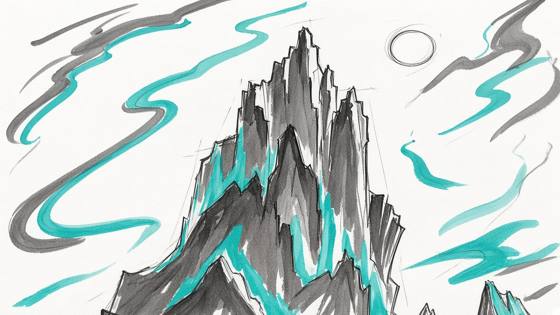 1 · window opens · 0:14.0 · 6.0s
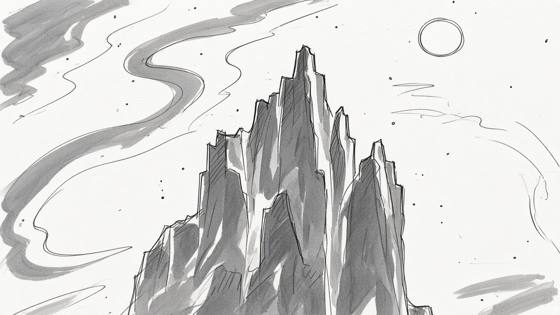 1B · same shot · 0:20.0 · 5.6s
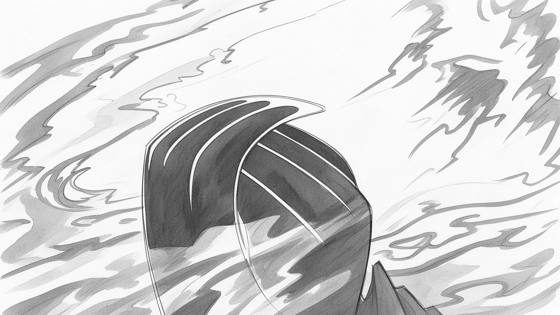 2 · CUT · 0:25.6 · 2.9s
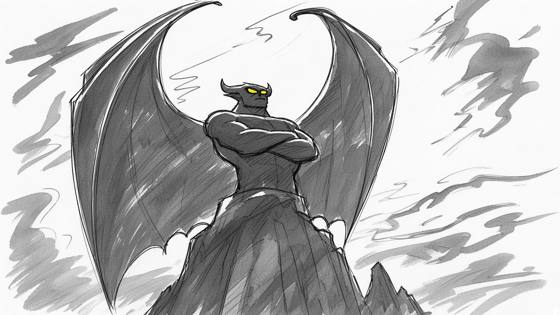 2B · same shot · 0:28.5 · 4.1s
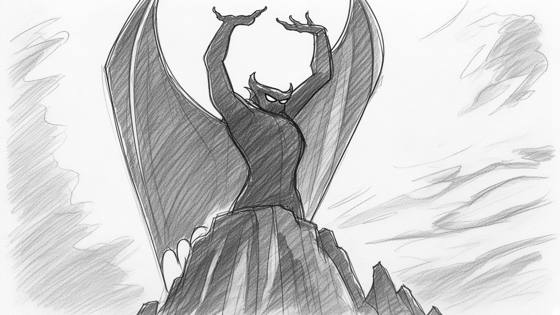 2C · same shot · 0:32.6 · 3.2s
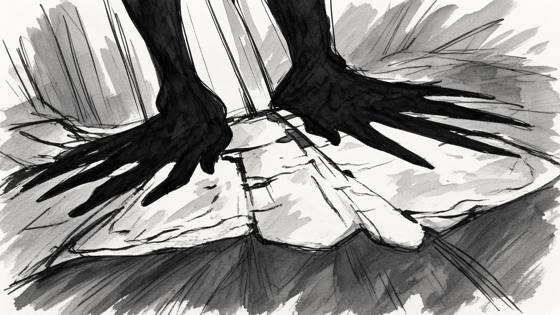 3 · CUT · 0:35.8 · 1.8s
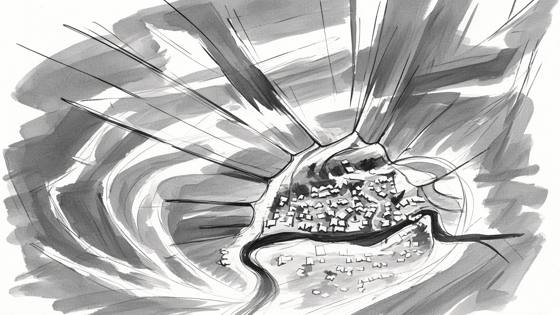 4 · DISSOLVE · 0:37.6 · 1.8s
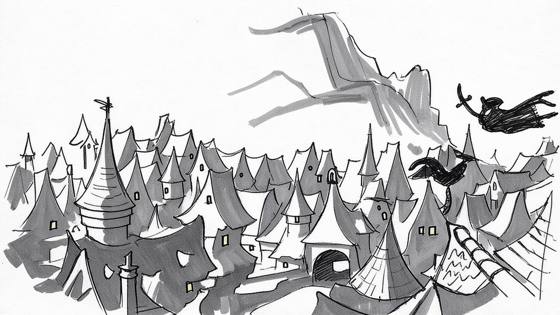 5 · CUT · 0:39.4 · 1.1s
Here's what the board shows that the movie hides: the camera stops. Panels 1 and 1B are a push-in, eleven-plus seconds of the camera doing all the moving. Then one cut, closer, and from 2 through 2C the camera is locked off for ten seconds while the drawing does everything. Tytla's devil opens like a fist, crosses his arms, raises them, reaches down. On the grid that's three panels of the same frame with a body changing inside it. The reveal isn't a cut to the monster. The reveal is the monster moving.
And look at the angles. Every panel of him is low, looking up. Then shot 3 flips it: high, looking down, his hand's shadow pouring over the cliff toward the village. The screen direction in this board isn't left and right, it's up and down. He rises, then his power falls. When the spirits finally move sideways over the rooftops in shot 5, it's the first horizontal motion of the night, and it reads like the music modulating.
The origin story fits too. According to the film's production history the design came from an Albert Hurter pencil sketch of “a demon sitting atop a mountain unfolding its wings,” later developed by Kay Nielsen. So the whole sequence grows out of one drawing of this exact gesture. That's a hook. You write the riff first and the song gets built around it.
Board 2 · 1:42–2:10The Summoning
8 panels · 5 shots · 1:42.0–2:10.0 (28s)
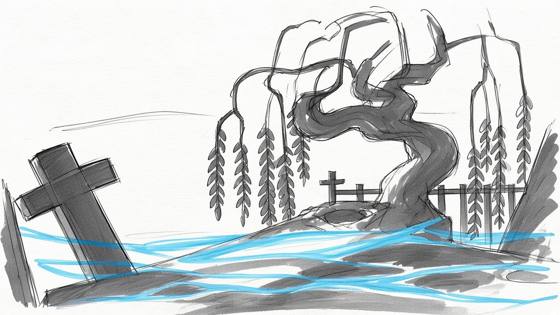 1 · window opens · 1:42.0 · 3.2s
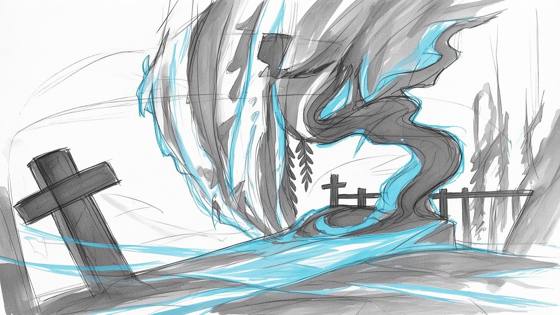 1B · same shot · 1:45.2 · 1.6s
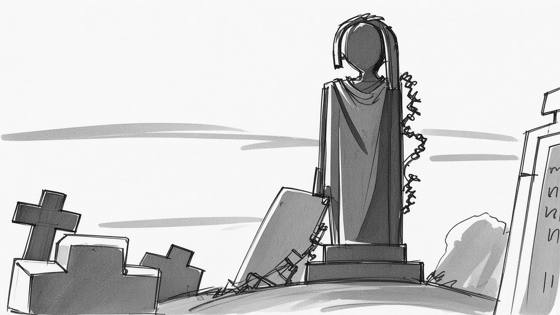 2 · CUT · 1:46.8 · 4.2s
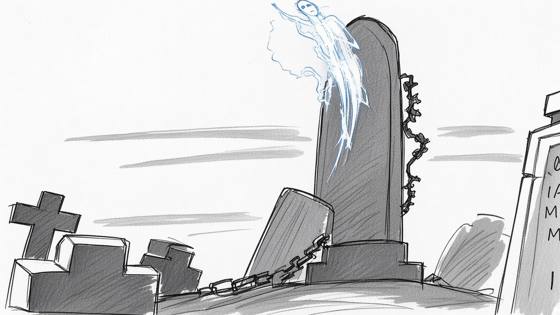 2B · same shot · 1:51.0 · 4.0s
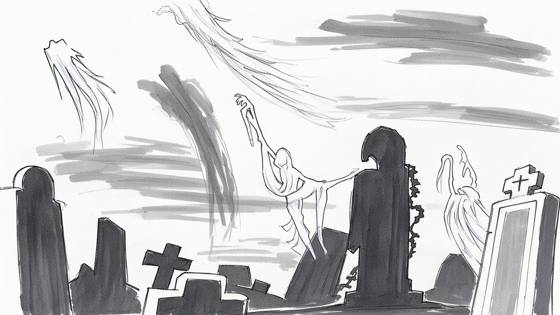 2C · same shot · 1:55.0 · 3.6s
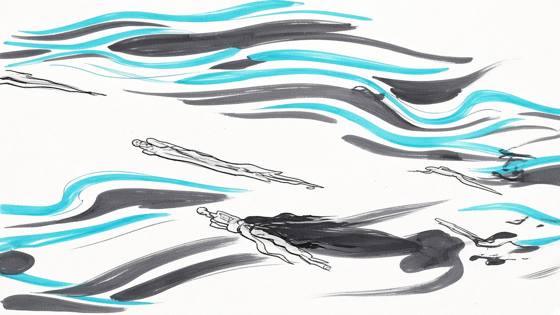 3 · CUT · 1:58.6 · 4.7s
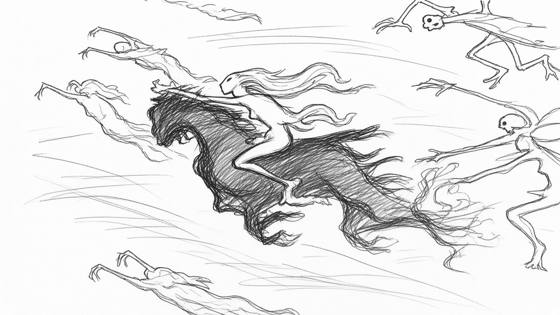 4 · DISSOLVE · 2:03.3 · 4.2s
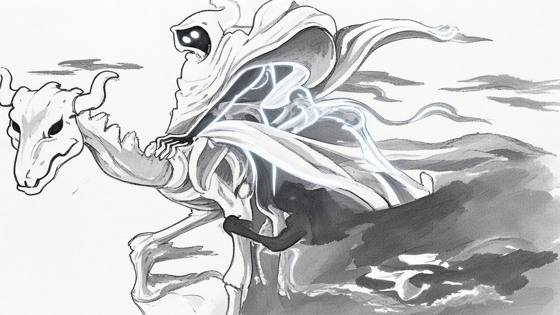 5 · CUT · 2:07.5 · 2.5s
When I first watched this I thought there was a cut around 1:57. The framing jumps. There isn't. I stepped through it frame by frame and it's a camera move, the camera sinking and drifting in while the spirits peel off the tombstones. Shot 2 runs almost twelve seconds and does the job of a montage: one wraith, then a few, then the whole graveyard rising, gathered by a single move instead of five setups.
Then the one hard cut in the middle of the board, at 1:58.6, and it's a big one. Everything has been going up for sixteen seconds; on the cut, everything is going right to left. Ninety degrees in one splice. That's the turn an arranger makes when the strings stop climbing and start running. The editing's real job here is to hold a direction for a long time so that one change of direction lands like a key change.
Board 3 · 3:34–4:02The Fire Dancers
10 panels · 7 shots · 3:34.0–4:02.0 (28s)
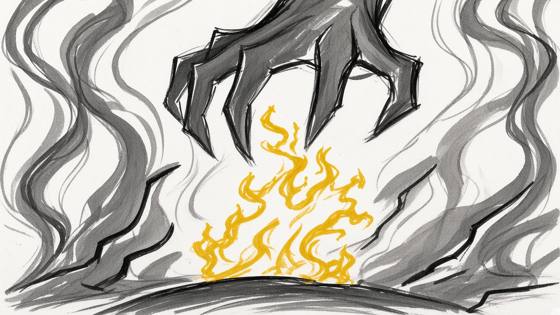 1 · window opens · 3:34.0 · 5.2s
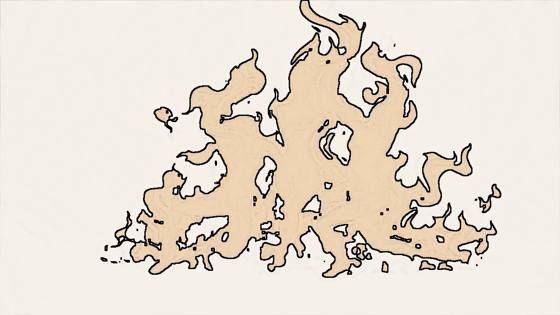 2 · CUT · 3:39.2 · 2.6s
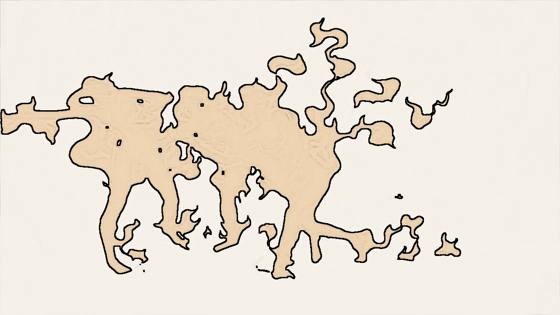 2B · same shot · 3:41.8 · 2.7s
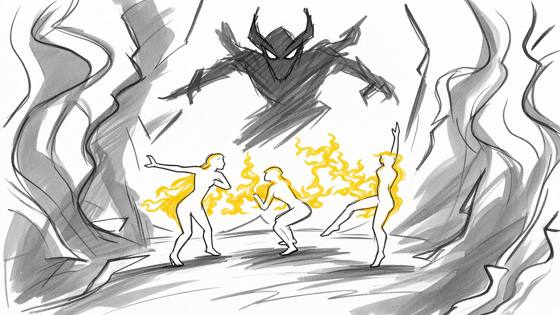 3 · CUT · 3:44.5 · 4.5s
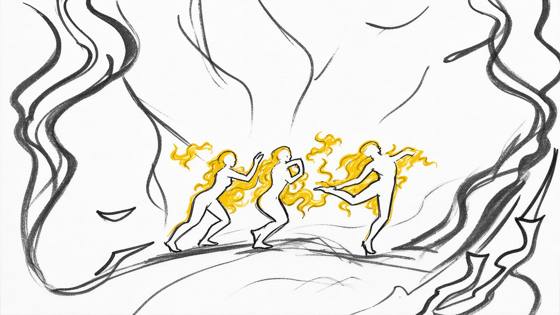 3B · same shot · 3:49.0 · 4.5s
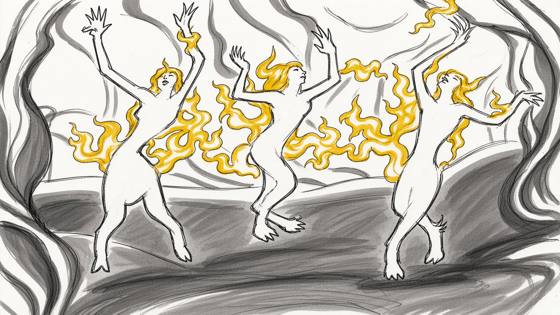 4 · CUT · 3:53.5 · 1.5s
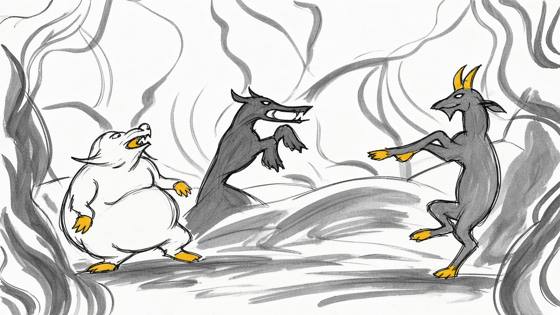 4B · same shot · 3:55.0 · 2.7s
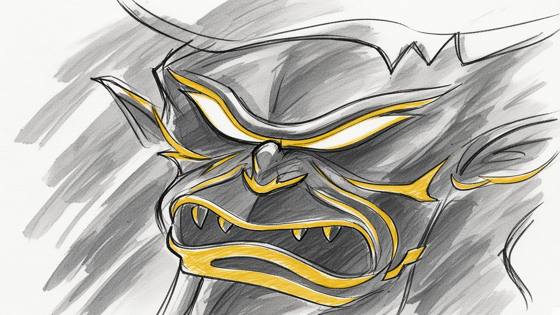 5 · CUT · 3:57.7 · 2.1s
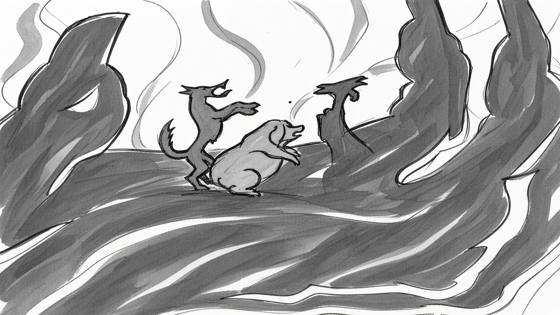 6 · CUT · 3:59.8 · 1.0s
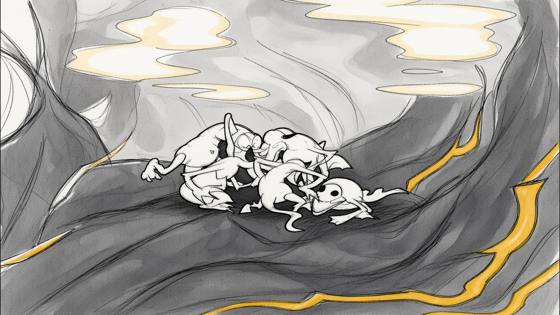 7 · CUT · 4:00.8 · 1.2s
This is the busiest board, seven shots in 28 seconds, and still the big changes aren't cuts. A flame becomes a mound becomes three women; three women become a pig, a wolf and a goat. Every one of those happens inside a shot, on a held layout. The cuts are about scale. Panel 3 goes wide and high and you suddenly understand the dancers are tiny and standing in his palm. Then 5, his face, two seconds, as big as the frame. Then right back to the hand. Small, small, enormous, small. That's a drummer dropping one rimshot into a pattern of ghost notes.
The transformation is the edit. Fire doesn't need a cut to become a woman, it just does it, and the animation carries you across like a slide on a fretboard where you'd expect a jump. It's the thing animation can do that live action has to fake with a dissolve, and this sequence leans on it so hard that the actual cuts start to feel like events.
Funny footnote from the board: in panel 3, Grok drew the devil looming over the dancers. He isn't in that frame. There's a dark shape the frame implies is him, and Gemini's cold read of the scene praised it for “keeping the demon consistently looming in the upper frame,” and the drawing model drew what it was told instead of what was there. Boards from story notes do that. They draw the plot.
Board 4 · 5:55–6:23The Bells
11 panels · 5 shots · 5:55.0–6:23.0 (28s)
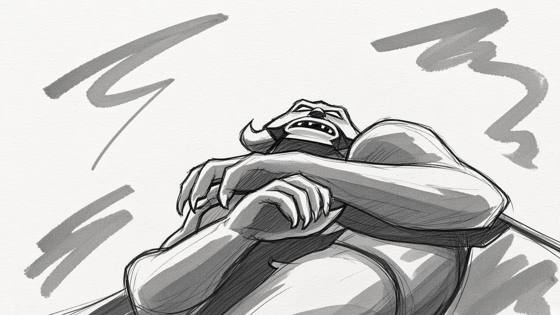 1 · TOLL 1 · 5:55.0 · 3.5s
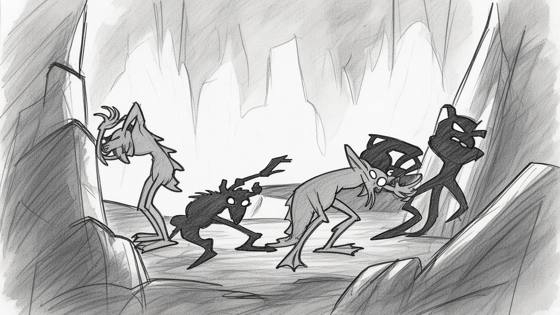 2 · CUT · 5:58.4 · 3.2s
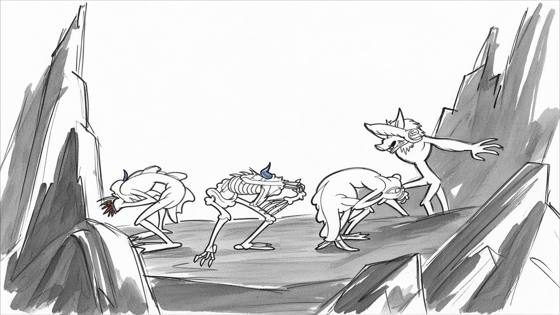 2 · TOLL 2 · 6:01.7 · 2.5s
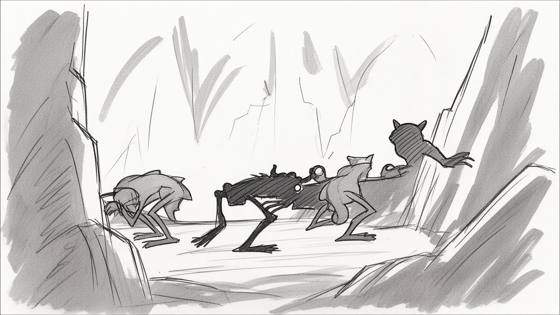 2 · light · 6:04.2 · 1.8s
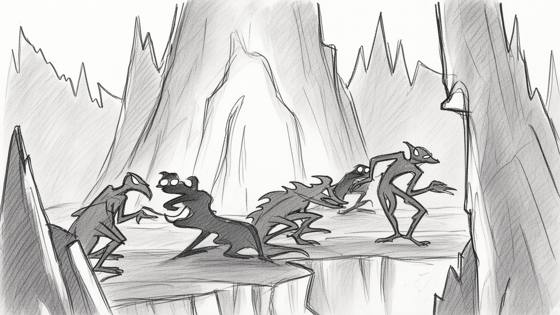 3 · CUT · 6:05.9 · 1.8s
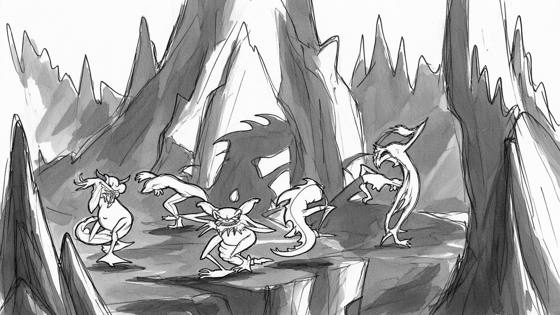 3 · TOLL 3 · 6:07.7 · 2.8s
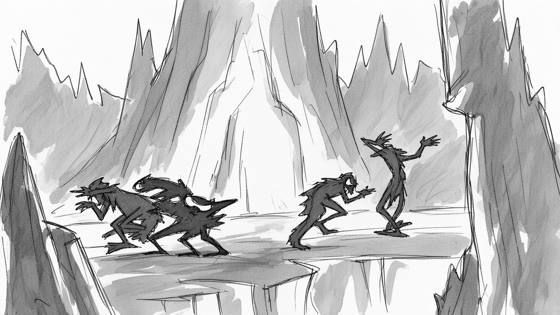 3 · light · 6:10.5 · 2.5s
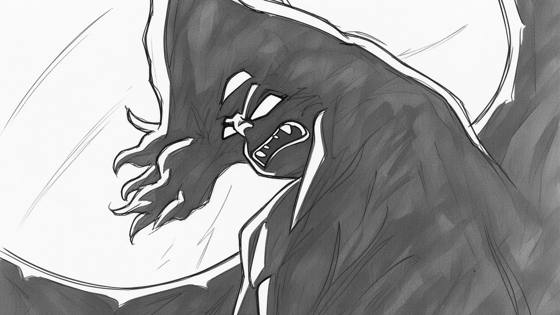 4 · CUT · 6:13.0 · 2.0s
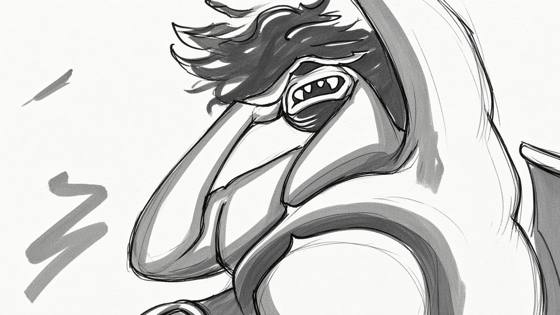 4 · TOLL 4 · 6:15.0 · 2.7s
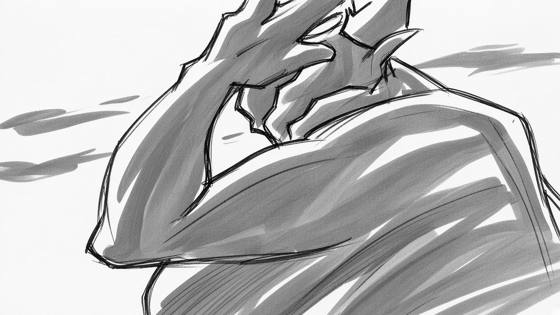 4 · light · 6:17.7 · 4.5s
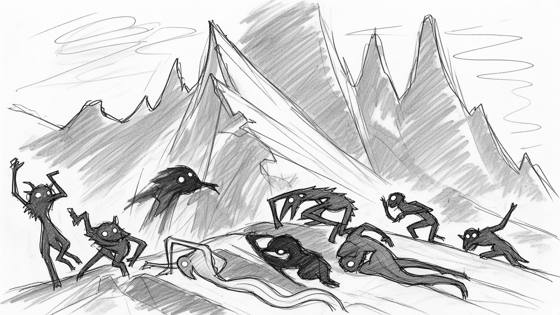 5 · CUT · 6:22.2 · 0.8s
Okay, here's the part that kills me. I didn't know where the bell was, so I pulled the loudness out of the soundtrack and looked at a spectrogram. Four isolated strikes, at about 5:55.5, 6:02, 6:08 and 6:15, each one a clean stack of bell partials, roughly six and a half seconds apart, with near silence between. Then I laid the board next to it. Every toll is a light change. Toll 1 lights the devil and he goes dark as it rings out. Tolls 2 and 3 flash the dancing demons into skeletons for two and a half seconds, inside a continuous shot, same layout, and then the color comes back as the bell decays. Even the board's motion arrows flip on the toll: they're dancing left to right, the flash hits, they recoil the other way, the light fades, they go back.
And the cuts? Every real cut in this board sits in the gaps between tolls. 5:58.5, 6:06, 6:13. The bell gets the downbeat. The edit lives in the rests. Fantasia's program calls it an Angelus bell driving the spirits back, and that's the story. The craft is that the bell is the only thing in the sequence behaving like an editor. It decides when the picture changes state, and the picture just waits for it.
My second reader (I run every one of these past a different model cold) caught the thing I'd flattened. On toll 4, the cut to the devil lands about two seconds before the bell. Tolls 1 through 3 hit inside shots. Toll 4 breaks the pattern: the picture gets there first, holds on him in the dark, and makes you wait for the strike with him. Then it lands, he's lit blue, the hand comes up, he wraps himself in his wings. For six minutes he's been the one doing everything to everyone, making fire into women and women into goats. This is the first time something does something to him. That's the turn, and the editing earns it by breaking its own rule once.
Board 5 · 7:20–7:50The Fold
7 panels · 3 shots · 7:20.0–7:50.0 (30s)
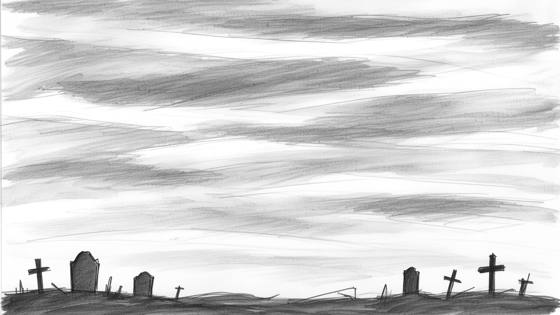 1 · window opens · 7:20.0 · 4.5s
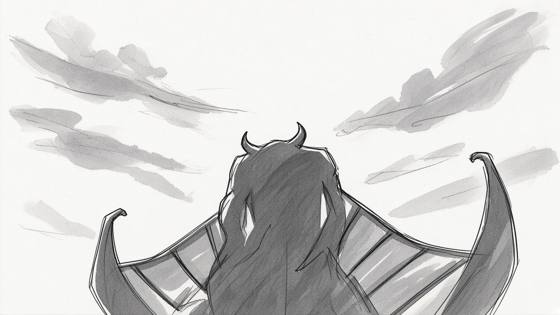 2 · DISSOLVE · 7:24.5 · 4.0s
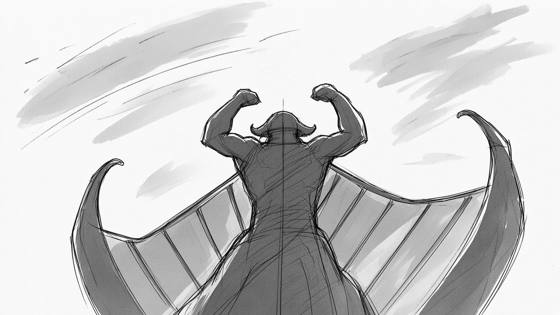 2B · same shot · 7:28.5 · 4.0s
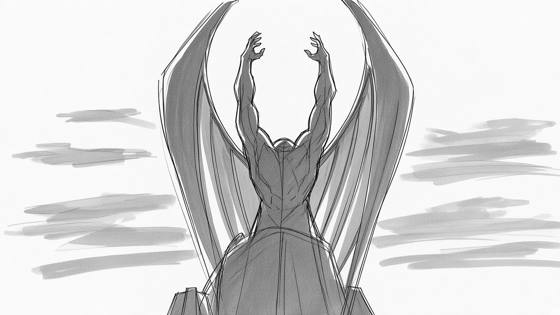 2C · same shot · 7:32.5 · 3.0s
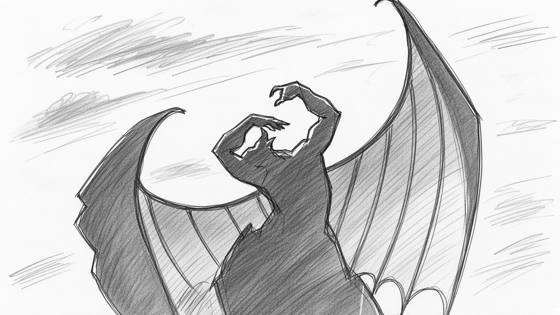 2D · same shot · 7:35.5 · 3.5s
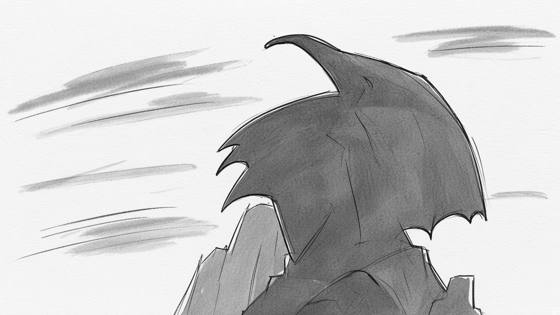 2E · same shot · 7:39.0 · 3.6s
 3 · DISSOLVE · 7:42.6 · 7.4s
Before the fold, the night runs itself backwards. After the last toll a single melodic line starts climbing out of the wreckage, and the spirits that poured up out of the graveyard in Board 2 get sucked back down. It's the summoning in reverse, a long funnel of ghosts, and then a tilt up off the gravestones into empty blue sky.
Then this board is basically one shot. Two dissolves and an eighteen-second take where he rises out of the sky, lifts his arms, and folds himself into the peak. Same locked-off camera as the unfold. Same low angle. Same arms-up pose, and you can lay the two frames side by side. Right around where the fold starts the low end drops out of the orchestra, the texture goes quiet, and it sounds like voices sneaking in underneath. The sound turns the page before the picture finishes.
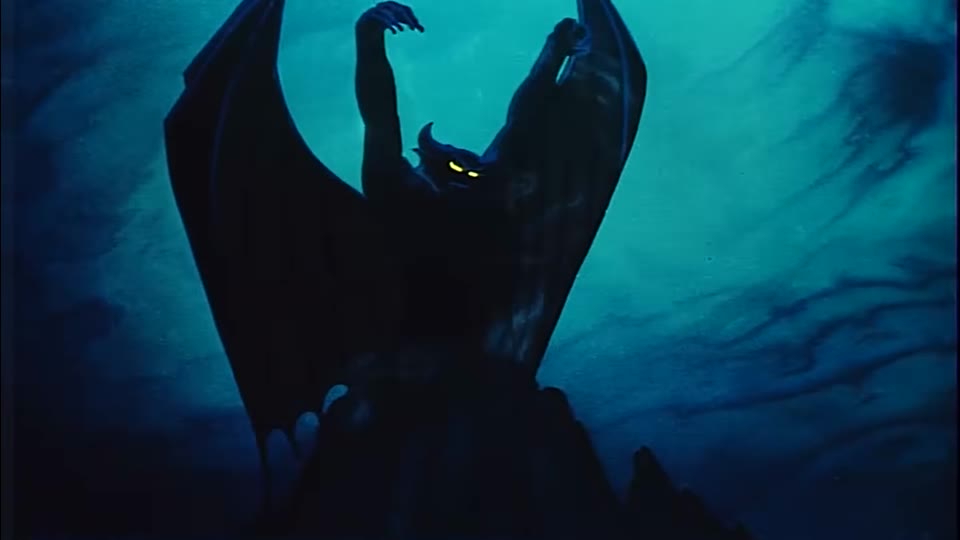
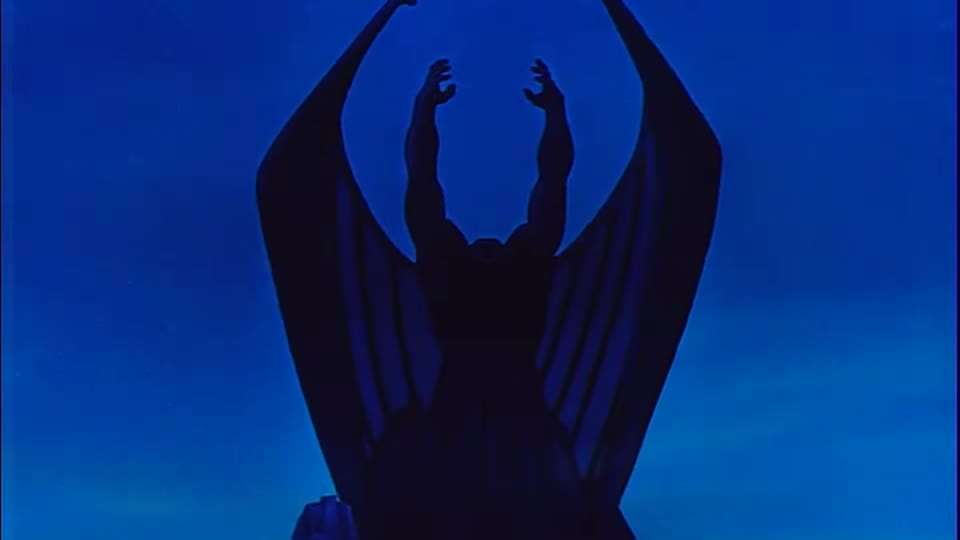
Second reader pushed back on my word “palindrome,” and fair. It's not reversed footage. Somebody drew the fold fresh, a new performance of the same phrase in the opposite direction, which is harder and better than running the film backwards. It's the way a song states the hook at the top and hands it back inverted at the end so you feel the circle close without hearing a repeat. Nobody beats him, either. No hero. Morning shows up, a bell rings, and he goes back to being geography. The evil doesn't die. It goes dormant and becomes the landscape again, which is a creepier ending than a victory.
And then the coda. The mountain melts into mist, a steady vocal line arrives as the Ave Maria comes in, and lights move through the trees in one long, slow, sideways move. After a night that refused to cut, the dawn barely even moves. Disney wanted the Ave Maria to have little animated movement and let the backgrounds carry it, and the production history around the final procession shot (217 feet of film, reshot over and over, the wrong lens, a small earthquake, finished a day before the premiere) tells you how much it cost to make stillness that smooth. Ed Gershman's line about it is the best thing I read this week: “a difference in the width of a pencil line was more than enough to cause jitters.” Calm is the hardest thing to animate. Ask anyone who's tried to play a ballad slow without rushing.
What the machines heard
I want to be honest about the tools, because they kept making the same mistake and the mistake is the lesson. The cut detector heard 1,541 cuts. The first visual pass I ran said the climax was a “sensory overload” of “fast cuts.” The storyboard tool's cold continuity read, looking at my panels without knowing which ones were the same shot, flagged the fold for “jarring jump cuts in the character's arm positions” and told me to “let the animation play across sustained single shots.” Which is exactly what the film does! It read my B and C panels as cuts because a modern eye expects that much change to need a cut.
That's the thing to sit with. In 1933 Alexeieff and Parker made their own Night on Bald Mountain on a pinscreen, and Cartoon Research describes it as “a stream of consciousness barrage of images.” That's the version the music seems to ask for. Disney's version goes the other way. A barrage of transformations, held together by an almost stubborn refusal to splice. The music is violent. The cutting is patient. The violence lives inside the frames.
A side note on clip hygiene. The upload I was first handed as the “theatrical cut” turned out to be a 2009 concert in Delft: the Koninklijke Harmoniekapel, a Dutch wind band, playing the score live to the picture. No strings; reeds and brass covering the string parts. Everything above is timed against the 1940 soundtrack in the two-part upload. But the fact that a wind band can play this live and have it still land on the picture tells you the timing is built on phrase and gesture, not on one orchestra's colors. Which, honestly, is a compliment to the board.
Steal list
- Change state, not shot. Hold the layout and flip the light, color or texture on the hit. The demons-to-skeletons flash resets the whole emotional register without breaking space. For a music video: keep the frame, flash the grade on the snare.
- Cut in the rests. If something in the track is acting like a downbeat (a bell, a kick, an 808), give it the picture change and put your actual cuts in the gaps. The hit gets to be an event, and the edit stops competing with it.
- Break your rule once, early. Toll 4's cut arrives two seconds before the sound. After three tolls of “picture changes on the hit,” landing early makes the audience wait for the hit with the character. That's dread, built out of one shifted cut.
- Make the reveal a gesture. Lock the camera and let the subject do the revealing. A push-in followed by a locked frame that something opens inside of reads bigger than any whip-pan.
- Bookend with the same phrase inverted. Open on a move, close on its mirror, drawn or shot fresh. The audience feels the circle close.
I keep coming back to the bell. Last time, in the Agni Kai, the score was the thing holding Azula together and the scene took it away. In Bellbottoms the beat hid every cheat in the geography. Here the sound isn't hiding anything or holding anyone up. It's running the session. Four strikes of a bell, and the devil, who spent six minutes editing everyone else's bodies, finally gets edited.
Keep swimming,
Mac
Second-reader note: this breakdown was pressure-tested against an independent cold read (GLM 5.2), given my first impression and verified notes but not this thesis. Its best catches survived and are built in above: toll 4's cut arriving before the sound, “palindrome” being a newly drawn rhyme rather than reversal, and the skeleton flashes landing on tolls 2 and 3 (I'd said the first two). Its framing, “transformation can replace cutting,” is where I ended up too.
How the boards were made: cuts measured by hand against 4-frame-per-second contact sheets (automatic detection is useless on fire animated on twos), then Gemini broke down each shot cold, and Grok Imagine redrew each mid-shot frame as a pencil panel. The companion page puts every panel next to its real frame, with the machine's cold continuity read for each window.
Sources
- Fantasia (1940) Night on Bald Mountain (1/2) and (2/2) — YouTube, 4:44 + 4:01 (the 1940 soundtrack; all timings above)
- Night On Bald Mountain — Fantasia (Theatrical Cut) — YouTube, 11:31; audio is the Koninklijke Harmoniekapel Delft live-to-picture concert, 14 Nov 2009, not the 1940 orchestra
- Fantasia (1940 film) — Wikipedia: Hurter sketch, Nielsen, Jackson and Tytla, Lugosi and Jackson reference, Angelus bell, Ave Maria production and the Gershman quote, click track
- Bela Lugosi Spends the Day at the Disney Studios for Fantasia Reference Work — D23
- Animating Forces — Disney Cicerone (on Tytla, quoting Thomas & Johnston)
- A Spooky Thunderbean Thursday: “Night on Bald Mountain” (1933) — Cartoon Research, on the Alexeieff–Parker pinscreen film