The Final Agni Kai — Score the Heart, Not the Fight
Six minutes and nine seconds, and for the middle two of them nobody says a word. Two siblings try to burn each other down in front of an empty throne, and the thing carrying you through it is a string piece — slow, mournful, totally uninterested in being exciting. I want to start there because it's the whole argument: this fight is not cut like a fight. It's mixed like a duet. And the duet is a eulogy.
Watch it with fresh eyes and you don't even need the show. Zuko's fire comes out in arcs — big, sweeping, circular phrases, the moves of a guy who spent three seasons learning how to breathe. Azula's fire is blue and it is a shiv. Straight lines. No curve in it. Precision as pathology. Two instruments, two timbres, and the edit just lets them trade bars. You could mute the dialogue track for the entire series and still know exactly who these people are from the shape of their flames. That's not worldbuilding trivia, that's the cut doing character work.
A metronome of a room
Before anyone throws a punch, the scene builds its own time signature. The coronation courtyard is drawn symmetrical — pillars, braziers, the long axis down the middle — and the early shots honor that geometry: wide, formal, patient. Azula challenges Zuko and the camera does a slow push-in on her face that ends in an extreme close-up of eyes that are smiling in a way eyes shouldn't. Then the standoff: slow cuts, a low rhythmic figure in the score like a war drum, Azula casting off her ceremonial robe. Everything is on the grid.
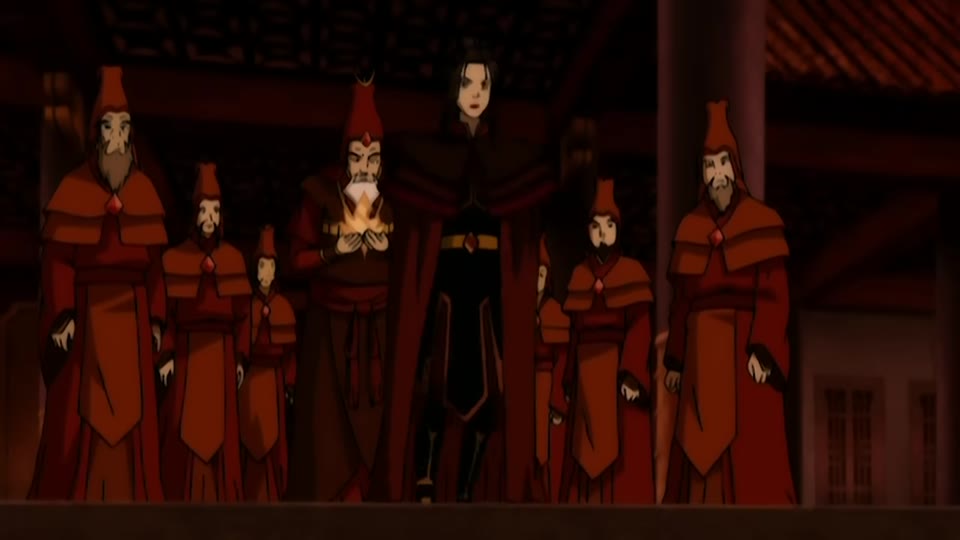
Hold onto the robe, because it's doing hidden work. She walks in wearing the crown ceremony and she fights in bare feet. The costume change is the character arc, compressed into one gesture — the last piece of Ozai's approval hitting the floor. My second reader caught that before I did and it's right.
And the symmetry isn't decoration. It's load-bearing. Control, for Azula, is a structure — a ritual, a tempo, a room that behaves. The scene spends a minute building that structure so it can spend four minutes dismantling it.
Score the heart
Here's the production fact that rearranged my head. In the Newsweek oral history of the finale, Bryan Konietzko says Jeremy Zuckerman was stumped on the scene — burned out like the rest of the crew — until Konietzko suggested a simple chord change. And then he names the lineage: Kenji Kawai's score for Oshii's Ghost in the Shell, where Oshii told Kawai not to score what was happening externally in the action, but what was happening in the Major's heart. And before that, Vangelis under Zhora's death in Blade Runner. Score the heart, not the fight.
That's the trick and it's devastating. An action scene wants percussion. This one gets a slow, sad string line — the edit rides that — and suddenly every blast of fire is happening inside a grief that's already happened. The fight isn't tense. It's mourned, in real time, while it's still going.
And they committed to it in the mix, which is the part editors should underline. Konietzko again: Ben Wynn built all this huge fire sound design, and at the mixing session they turned it down — filtered it, sank it under the music, explicitly chasing the Vangelis Zhora scene. They had the expensive, correct, sounds-like-fire option and they chose the strings. Sound design loses the mix on purpose. How many action scenes have the nerve to do that?
The pillars know
Dos Santos, in the same oral history, gets almost shy about his own contribution — gives the credit to Konietzko, DiMartino, Zuckerman — but mentions one staging detail he fought for: Zuko's feet skidding backward under the force of Azula's blasts. Weight. Consequence. It sounds small and it's everything, because it means every hit in this fight lands on somebody's body, not just on the frame.
Watch how the two of them treat the set, too — this is my favorite hidden thing in the whole scene. Zuko dodges around the pillars. Azula goes through them. He adapts to the environment; she consumes it. Every exploding column is a character beat with no dialogue attached. By the end the courtyard is rubble and the compositions have gone crooked — the symmetrical wide shots from the standoff are gone, replaced by tilted, reactive framing — and it takes you a second to realize the room and the girl came apart on the same schedule. The set is her psyche. They built a metronome of a room just so the fight could knock it off the beat.
There's also a geography thing a casual viewer never clocks: the fight moves down. It starts on the pristine ceremonial platform and spills — up into the air, then onto lower roofs, then into the dirt and the grates. Royalty dueling in a throne room becomes two kids scrambling in the mud. The descent is staged so smoothly you feel it instead of noticing it.
The turn is a mixing-board decision
Azula's down. Zuko taunts her — go on, generate lightning, I'll redirect it. And the entire orchestra leaves the building.
Gone. In its place: a thin electric whine. A power line where a string section used to be. Six minutes of the biggest music the show ever made, and the single most important moment in the fight is scored by one sustained electrical crackle. Then slow motion — the only slow motion in the sequence, earned and spent in one place — Azula's aim drifting past Zuko toward Katara, the whip to Katara's face, the extreme close-up of Zuko's eye, the dive. And the hit itself is nearly subliminal: a white flash, a frame or two.
My second reader pushed on my read here and I think they sharpened it: this isn't just a dramatic moment, it's an expectation cut. The whole scene has trained you that fire is loud and music is huge, and the climax refuses both — it compresses the decisive blow into a blink, scored by a sound with no music in it at all. A shock cut wearing a dramatic moment's clothes. Everything before it was the show. This was the point.
Aftermath: the grammar changes
And then — the thing almost nobody talks about — the fight's editing grammar switches. While it was Zuko and Azula, it was a duel: formal exchanges, trading bars, call and response. The moment Katara takes over against a giggling, unmade Azula, the camera goes reactive, chase-minded, hunting through smoke and broken pillars. Duel grammar becomes survival grammar. Same location, same characters, different genre — and the cut tells you before anyone says a word.
Katara's trap is its own little masterclass: close-up on her eyes, cut to the grate, cut to the chains, back to her face. The edit hands you the pieces of the plan before it springs, so the tension isn't what will happen — it's will the timing work. Then the rushing water, and then the sharpest sound/picture sync in the whole clip: the crack of the freeze, her and Azula locked in ice, the fight ending not with an impact but with a stop. The percussion just ceases.
Hold the ugly shot
The ending is the bravest mixing decision of all: nothing. No score under Azula's breakdown. A girl chained to a grate, screaming, breathing fire at the sky like a stuck valve, and the camera holds a medium shot and does not move and does not cut away to Zuko's face or Katara's tears or anything that would let you off the hook. In Cut #3 I talked about the held shot against the beat — when the whole edit rides a rhythm, you spend your one long hold where the argument turns. This is the same money spent even harder: the whole scene rode a score, so the final hold is scored by absence. Just her. As long as you can stand it. Then longer.
Dos Santos called the ending “incredibly tragic” — his takeaway was Zuko having to watch his sister reduced to pure feral rage, and then he laughs a little in the interview: “again, kids' show.” Yeah. Kids' show. Feature-level boards from Dean Kelly, a murderers' row of the crew throwing in (his words), a Vangelis reference in the mix notes, and an ending with no music and no mercy. Dos Santos also said he nearly cried seeing the rough edit with the score for the first time — the first time a kids' animated series had pulled that out of him. Same, man. Eighteen years later, same.
One fence, clip hygiene: the YouTube clip runs past the duel into the Katara fight and the aftermath, which is Sozin's Comet, Part 4 territory — the Konietzko/Zuckerman scoring story is about the Part 3 duel proper. Dos Santos directed both parts, so the through-line is real, but the Ghost in the Shell note belongs to the duet, not the chase.
My second reader's sharpest pushback: I said the cut rhythm mirrors who's winning emotionally. They said no — sharper than that. The scene argues that control is an illusion maintained by environment and sound. The symmetry, the ceremony, the tempo map, the huge mix — that's the scaffolding holding Azula together. The fight doesn't defeat her; it removes her structure, piece by piece, and she comes apart on her own. I sat with that for a day. They're right. The Agni Kai isn't a fight Azula loses. It's a building demolition where she is the building, and the edit is the crew that knows exactly which pillars to pull.
Steal list (Cut #5)
| Technique | Where | Steal as |
|---|---|---|
| Color as melody | The whole duel | When there's no dialogue, let a visual element carry the line — two timbres trading bars |
| Sound-led cut | Appa's roar interrupts the ceremony, 0:03 | Let an offscreen sound yank the cut — more immersive than a picture edit |
| Score the heart | Duel montage, 1:36–2:35 | Counterscore the action: sad strings over violence mourns it in real time |
| Turn the design down in the mix | Konietzko on Wynn's fire SFX | When the music is the argument, sink the “correct” sound effects under it on purpose |
| Set as psyche | Pillar destruction throughout | Destroy an orderly space on the same schedule as a character's collapse |
| The mix-drop turn | Lightning charge, ~2:47 | Before the biggest moment, strip the mix to one thin non-musical sound |
| Puzzle-box eyeline | Katara's grate/chains, ~4:20 | Hand the audience the trap's pieces in close-up first; tension becomes timing, not surprise |
| Hold the ugly shot | Azula's breakdown, 5:48 | At the lowest point, kill the score and don't cut away |
Last time out, Baby Driver argued that rhythm is continuity — snap chaos to the downbeat and the ear forgives everything. The Agni Kai is the dark twin of that idea. Here the downbeat is the thing that's holding somebody together, and the scene's whole job is to take it away. Cut #4 hid the metronome so you could ride it. Cut #5 shows you the metronome so you can hear it stop.
Keep swimming,
Mac
Second-reader note: this breakdown was pressure-tested against an independent close reading (GLM 5.2). Its best catches — the robe as shed ceremony, around-the-pillars vs. through-the-pillars, the downward geography, the lightning hit as an expectation cut — survived contact and are built into the reading above. Its frame of the scene as “control is an illusion maintained by environment and sound” is where my thesis ended up.
Sources
- Zuko + Katara vs. Azula 🔥 FINAL FIGHT | Full Scene — Avatar Legends (official), 6:09
- Avatar: The Last Airbender Creators on the Finale, 10 Years Later — Newsweek oral history (Konietzko, DiMartino, Dos Santos, Spaulding)
- Toon Zone Interviews Joaquim Dos Santos on Directing Avatar — Anime Superhero (2008, pre-finale)
- Avatar Shares Original Agni Kai Storyboards — ComicBook.com
- See the Pencil Tests for Avatar: The Last Airbender’s Best Fight Scene — Gizmodo