Whiplash ‘Caravan’ Finale — Who Counts the Band In
I remembered this as the fast-editing scene. Everybody remembers it as the fast-editing scene — it’s the one that won the Oscar, the one that made drumming feel like a contact sport. So I sat down to watch the speed, and the speed is the least interesting thing about it. The first forty seconds are slow. Fletcher talks to the audience, Andrew sits down at the kit, the room breathes like a room. And then one cymbal crash cuts Fletcher’s sentence in half and I realized what the scene is actually doing: it’s a nine-minute fight over who gets to count the band in. Everything else — the sweat, the blood, the smile at the end — is just the scoreboard of that fight.
Because a count-off is authorship. Whoever says one, two, three, four owns the next four minutes of everyone’s life. Fletcher has owned every count in this movie. And at 0:17, a nineteen-year-old steals the metronome.
Make it a fight scene
Start with how it got built, because the making-of is the analysis here. Chazelle shot the whole film in nineteen days, which means nothing this complicated could be found on set — so he storyboarded the finale and cut a full animatic synced to the music before anyone rolled a frame. Tom Cross told the LA Times the reference wasn’t a concert film at all: it was Raging Bull. Make it feel like a boxing picture first and a music scene second. Chazelle’s own brief, per /Film’s breakdown, was that the music scenes should play “like fight scenes: violent and brutal.” A jazz movie cut with action-film grammar — the New York Times Below the Line piece has Cross describing smash-cuts, cutting during movement, cutting a beat earlier than your eye expects, even deleting individual frames to make hits land harder. That’s fight choreography. The drum kit just happens to be the ring.
But here’s the part that matters: the first assembly didn’t work. Cross has said they started the edit with this sequence — Chazelle had the clearest vision for it — and the first pass was technically dazzling and emotionally empty. All mechanics, no story. So they recut it around two faces. Andrew goes from attacking Fletcher to inheriting him; Fletcher goes from fury to recognition. Once you know that, you can see it in every shot choice: the instruments are the fight, and the eyes are the score.
The edit changes drummers
Watch the opening again with this question: whose sound is the cut obeying? For the first sixteen seconds, the picture cuts on Fletcher’s speech — his rhythm, his pauses, his room. Then Andrew crashes in mid-sentence, and the cut doesn’t accompany the crash. The crash causes the cut. My second reader named it perfectly: that’s the moment the edit’s timebase gets handed from the conductor to the drummer, and nobody announces it because that’s not how time works — it just starts obeying someone else. Every cut for the next nine minutes answers to the kit.
And then the line: “I’ll cue you in.” It’s a drummer doing a drummer’s job, and it lands like a coup, because it is one. Fletcher’s jaw in the reaction shot — he hears it. He spends the next four minutes conducting a tempo he didn’t set, which for Fletcher is a fate worse than the sabotage he planned.
Brass is percussion
The big-band stretch is where the Raging Bull note pays off. The horns aren’t shot as musicians; they’re shot as machinery — trombone slides, trumpet mutes, sax keys, piano hammers, each one cut against the limb of the kit that’s answering it. In a big band, brass is percussion: short attacks, tuned punches, arranged hits. Cross just films the truth. There’s even an insert of the chart — solo ad lib — which is the whole movie in two words of music engraving: here is the space where the written thing stops and the person starts.
Two cuts ago, in Star Guitar, Gondry’s claim was that the world was already on the grid — railway poles already think like dance music. This is the same religion in a cathedral instead of a field: a big band is a human sample library, and the drummer is the sequencer. The difference is that Gondry’s grid is benevolent and this one is a cage match. Andrew isn’t accompanying the band. He’s driving it like a stolen car.
Refusing the finish
The turn isn’t the nod at the end. The turn is earlier and meaner. At 4:37 Fletcher closes his fist on the last note of “Caravan” — the cutoff, the conductor’s oldest weapon, the gesture that says time stops because I say so. The band obeys. The frame goes nearly black. And in the dark, alone, Andrew keeps playing.
That refusal is the whole character arc in one disobeyed gesture, and Cross stages it in the soundtrack before the picture: the orchestra drops out and what’s left is naked, dry, ugly-beautiful drums — no arrangement to hide behind. “Andrew, what are you doing, man?” “I’ll cue you.” The line comes back, and this time it’s not a coup. It’s a fact.
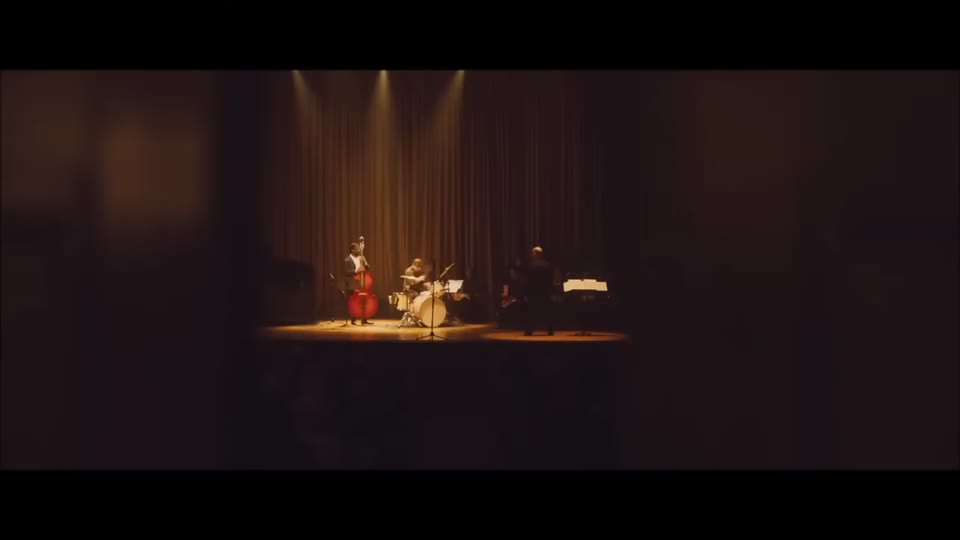
And then — this might be my favorite shot in the sequence — at 6:50, at the most exposed moment of the solo, Cross and Chazelle go to the widest shot in the entire film’s finale. Back of the hall. The band gone, the stage tiny, one kid in a pool of light. Every instinct says go closer when it gets intense. They go all the way out, because the geography isn’t information anymore — it’s the emotion. Wide equals alone.
A hand on brass
The actual turn — the one I misread for years — is a cymbal. Around 7:00 Andrew’s ride starts swinging loose, and Fletcher steps in and steadies it. That’s it. No score swell, no held close-up, no underline. A hand on brass, half a second, and the adversary becomes the collaborator. My second reader relocated the turn there and I’m conceding it in print: “I’ll cue you” is the theft, the nod at 9:20 is the receipt, and the cymbal catch is the moment conduct stops being demanded and starts being shared. Cross buries it in a functional insert because that’s what it would feel like from the inside — you don’t notice the war ending while you’re still in it. Underline a turn and you kill it.
Fast cuts, starving frames
Confession: in my first-impression notes I wrote that the ending “decelerates into the climax” — one snare, one roll, everything getting simpler. My second reader took that apart and they’re right: the cut rate in the final minute accelerates. What slows is the information per cut. One eye. One bead of sweat. One vein, one stick, the same roll. Cross drives a wedge between how fast the editing moves and how much each frame contains, until they’re running in opposite directions — the machinery sprinting while looking like it’s breathing. That’s why the ending feels like stillness at impossible speed. It’s manufactured, and it’s the best trick in the whole sequence.
Which connects to the honest discomfort underneath this scene: the drumming you’re hearing is assembled — Teller’s live playing, prerecorded passes, layered audio that Cross cheerfully admits is sometimes physically impossible for one human to perform. The virtuosity is an edit artifact. And I keep going back and forth on whether that’s a cheat or the point, because the movie is about the question of whether greatness is real or manufactured — whether Fletcher’s machine produces a Charlie Parker or just produces a guy who’ll destroy himself trying. The finale is literally manufactured greatness, cut together from fragments until it looks like transcendence. I don’t think that’s an accident. I also don’t know which side of the question the movie lands on, and I’ve stopped expecting to.
Zero decay
The ending is the cleanest execution of the whole philosophy. Fletcher raises both arms — he’s conducting again, fully, willingly, maybe for the first time serving something instead of owning it — the orchestra slams the unison hit, his fist clenches on the choke, and the picture goes to black on the fist. No ring-out. No fade. No breath. The same gesture Andrew refused at 4:37 is now the gesture that ends the film, and this time everybody obeys it, including the editor.
And the smiles before it — Fletcher’s slow grin, Andrew’s answering one — people read it as triumph or as horror, and the LA Times piece sits right on that ambiguity: breakthrough or successful programming, liberation or infection. The edit refuses to rule on it. The eyes do the verdict, and the eyes are fluent in a language the cut spent nine minutes teaching you. I said at the top this scene is a fight over who counts the band in. The awful, beautiful answer is that by the end they’re counting it together — and the movie never tells you whether Andrew won the fight or lost himself winning it. The cut just chokes the cymbal and walks offstage.
Steal list (Cut #8)
| Technique | Where | Steal as |
|---|---|---|
| Timebase transfer | The crash, 0:17 | Decide whose sound your edit obeys — then let a character steal it mid-scene, with no announcement |
| Cut earlier than the eye wants | The whole fight grammar | Cut during movement, a beat before expectation; delete frames to make impacts land harder |
| Cast sections as machinery | Brass montage, 3:38 | Shoot every instrument as moving parts answering the rhythm section; brass is percussion |
| The refused cutoff | Fist, 4:37 | Let a character ignore the edit’s ending — drop the accompaniment, hold near-black, keep the naked track running |
| Widest shot at the emptiest moment | Hall wide, 6:50 | Save your extreme wide for maximum isolation, not for geography |
| Bury the turn | Cymbal catch, 7:02 | Put the pivot in a functional insert with no score swell; underline a turn and you kill it |
| Cut rate vs. information density | Eye convergence, 9:16 | Sprint the cutting while starving each frame — acceleration reads as stillness |
| Smash to black on the choke | Final hit, 9:31 | End on the cutoff with zero decay; let the gesture you set up earlier be the last frame |
Keep swimming,
Mac
Second-reader note: this breakdown was pressure-tested against an independent close reading (GLM 5.2). Its best catches — the edit’s timebase changing hands at the crash, the cymbal catch as the real turn, and cut rate decoupling from information density — survived contact and are built into the reading above; two of them corrected my own first impression, and I said so where it happened.
Sources
- Whiplash (2014) — FULL ENDING Final Performance Scene — dvse upload, 9:40 (fan scene clip; matches the film’s finale)
- Anatomy of the climactic scene in ‘Whiplash’ — LA Times (Tom Cross on the animatic, Raging Bull, the ending’s ambiguity)
- How Damien Chazelle Cut Together Whiplash’s Complicated Drum Solo Scene — /Film (19-day shoot, layered “physically impossible” drumming, recutting around the faces)
- Below the Line: Editing ‘Whiplash’ — NYT Carpetbagger (smash-cuts, deleted frames, delaying expected cuts)
- Art of the Cut: Tom Cross, ACE on Whiplash, Joy and La La Land — ProVideo Coalition (visible vs. invisible editing; character arcs over spectacle)
- Rob Knook’s 25-minute video essay on the rhythm of Whiplash — The Film Stage (editing rhythm as jazz dynamics, loud/quiet rather than purely on-beat)