Star Guitar — The Landscape Is a Mixer
Four minutes out the window of a French train. That’s the whole video. No performer, no story, no second angle, and by the end of it I’ve felt a build, a breakdown, a drop, and a climax — the full emotional weather of a Chemical Brothers track — delivered by poles, sheds, gravel, and other people’s public transportation. I knew the trick going in. Everybody knows the trick; it’s the famous one. And about thirty seconds in it got me anyway, because knowing the rule and watching the rule hold for four minutes without flinching are two different experiences.
The rule: everything outside the window is an instrument. The catenary poles whipping past are the kick drum — one pole, one downbeat, you can count the song in fenceposts. When the round synth tone enters around eight seconds, spherical water towers start rising over the fields at exactly its interval. Little identical maintenance sheds are percussion. And when the vocal chop shows up — you should feel what I feel — it arrives as an entire passing train, carriage after carriage wiping the frame, one car per syllable. I laughed out loud the first time. Of course the voice is the loudest object in the world. Of course it is.
One rule, held for four minutes
What I keep coming back to isn’t the sync — it’s the faith. A lesser video does this gag for forty seconds and then cuts to something “exciting.” Gondry never once leaves the window. When the arrangement gets dense, the world gets dense — open fields give way to switchyards, switchyards to a depot — and that’s the spectacle. Around 2:13 the concrete bridge piers come slamming past on the synth stabs and it plays like the heaviest drop in the video and it is literally just concrete. He trusts the song to be the special effect.
And the “no cuts” thing is a beautiful lie, which is the part I love most. There are cuts — the footage is a composite of multiple passes — but they’re hidden behind occlusion: a bridge pillar, a wall, a whole train crossing the frame. The edit is happening constantly, it’s just wearing the world’s clothes. In Cut #6 I tracked how Fantasia’s editors put their cuts in the rests between bell tolls. This is the same religion taken further: don’t cut on the beat or between the beat — hide the cut inside an object that is the beat.
The oranges come first
Here’s how you actually build this, and it’s so much more handmade than the result looks. Before any train ticket got bought, Gondry sat with the track and transcribed it — beats, instruments, punctuations — onto graph paper, a visual score. Then he prototyped the whole looping landscape on the floor, walking a camera past rows of oranges, forks, VHS tapes, tennis shoes and books to test whether objects spaced like notes would read as rhythm. The making-of (it’s on the Work of Director Michel Gondry DVD) shows this and it’s the most charming pre-vis in film history: a dude crawling along the sidewalk filming fruit, proving a thesis about dance music.
Then the real thing: his brother Olivier — Twist — spent something like two weeks riding railways out of Paris scouting lines, and they shot the Nîmes–Valence stretch over and over, commonly cited as around ten passes at different times of day, on DV, camera locked on the window. Olivier edited; the composite and CG augmentation ran for more than two months at Twisted Laboratories. Gondry’s own note from the DVD booklet is the whole ethic in one sentence: “It’s all actual footage from a train, although some of the images are computer generated. My brother and I were working really hard to not have it look clearly like either CGI or video and really mixed up both techniques to create something different.” The uncanny cleanliness you feel — cottages repeating like a sample, identical white cars on the same road — is that mixed-up-ness. The scenery has a sample library because they built it one.
Depth is a mixing board
The quiet genius move is where things sit. Foreground — the motion-blurred fence slats and posts — carries the hi-hats and transients, the fast stuff. Midground carries melody: buildings, shunters, the station. Background, the slow parallax of hills and sky, carries the pads. That’s not a pun, that’s a mix. My second reader put it better than I had it: the focal plane is a crossover network. High frequencies are close, low frequencies are far — he’s rendering acoustics optically. An engineer’s brain made this video. It’s “Around the World” grown up: instead of dancers embodying each part, the entire French countryside does.
Watch the platform section for how casting works. The vocal loop gets the train carriages — the biggest, loudest object available, because it’s the voice. And the human beings — a pedestrian in a red shirt, people under the green awnings — get saved for the hook too, recurring on the loop like ad-libs. Four minutes of infrastructure and the only people in the whole video are scheduled like features on a track.
The night flash is not a vacation
Confession: in my first-impression notes I wrote that the sudden cut to night around 1:27 — sodium lamps, lit factory stacks, one bar of darkness and back — was the one moment Gondry “lets himself be a filmmaker instead of a conductor.” My second reader took that apart, and they’re right and I’m conceding it in print: the night flash is not an indulgence, it’s structural. The track needs a breakdown — a filter sweep, a dip in energy — and a daytime landscape physically cannot produce one. Night is the only filter sweep a world made of poles and buildings owns. Gondry doesn’t step outside his system there. He finds the system’s single escape hatch and takes it exactly once.
Same section, smaller catch: just before the flash there’s a gravel mound that maps to the transition sweep. Not a hit — a smear. A formless pile doing a timbral change. Every other object in the video is legible (pole = kick, tower = synth); the mound is the one thing the video can’t name, and it needs exactly one of those or the whole exercise turns into a diagram.
The world has a past tense
Two moments late in the video break the rule in the most productive way, and my second reader caught both. First, the limestone cutting around 2:25 — the train hugs a rock face and the strata and fractures race past as the hi-hats go to sixteenths. Except strata aren’t events. They don’t appear when the sound appears; they were always there, laid down over geological time, and the rail line just slices through and reveals them. Which flips the whole premise on its head: the arrangement pre-exists the camera. The train is the playback head.
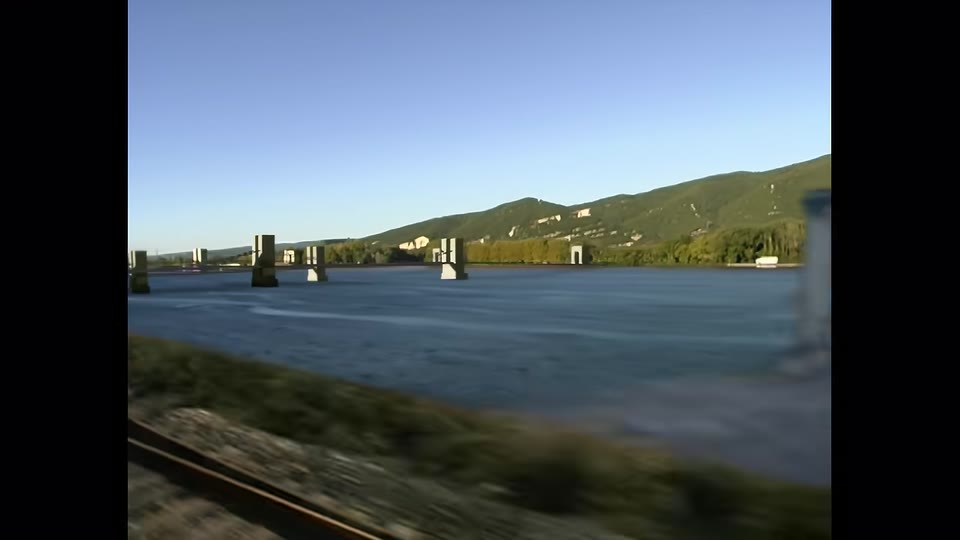
Then the river at 2:45, where the track pulls back to pads — and what’s standing in the water is a row of broken bridge piers. Ruins. Two minutes of accumulation, of the world adding stems, and the moment the arrangement breathes, the objects we’re shown are remnants of an older structure. Entropy as instrumentation. The world has a past tense. I genuinely don’t know if Gondry cast the broken bridge on purpose or found it on the pass and knew what it was worth, and honestly it doesn’t matter — recognizing the emotional value of a ruin at the exact bar the mix goes soft is the skill, whether it happened on graph paper or in the edit.
Everything at once, then home
The last minute is the depot — parallel tracks, gantries, parked carriages, orange locomotives, the maximum density the route can offer — and it plays as every stem unmuted at once. The windows and door-lines of the background trains strobe against the arpeggio. It’s the full mix, staged as a place. And then the song winds down and the video just… arrives. Because of course a song about travel resolves at a station. The form was a journey the whole time; we were the ones reading it as a mixer.
So what’s the video arguing? In Cut #4, Edgar Wright snaps the world to the track — gunshots and windshield wipers yanked onto the downbeat, rhythm as continuity. Gondry goes one step past that. He’s not syncing picture to music; he’s claiming the sync was already there. Railway infrastructure already thinks like dance music — poles at regular intervals are a grid, switchyards are quantized percussion, catenary wire is a timeline with a playhead. Editing and mixing aren’t analogous operations. They’re the same operation on different substrates, and one stubborn window frame is the proof. That’s the thesis I’ll defend: the trick isn’t the technique. The trick is that the technique works because the world was on the grid before anyone put a camera on it.
Steal list (Cut #7)
| Technique | Where | Steal as |
|---|---|---|
| Stem casting | The whole video | Transcribe the track to a stem chart, then assign one repeating object per stem — and never recast mid-song |
| Occlusion wipe | Every hidden cut | Hide cuts inside passing foreground objects; the world masks the edit |
| Depth as frequency separation | Foreground/mid/background split | Fast transients near camera, melody midground, pads in the far parallax |
| Physical pre-vis | Oranges on the sidewalk | Prototype spatial rhythm with junk on the floor before shooting a frame |
| The one escape hatch | Night flash, 1:27 | Find your system’s single allowed exception and spend it exactly once, at the breakdown |
| Cast the voice biggest | Carriage wipes, 1:53–2:12 | Give the vocal the largest object in your world; mix with scale, not just level |
| Entropy as instrumentation | Broken piers, 2:45 | When the mix goes soft, show remnants instead of objects — decay is a texture |
Keep swimming,
Mac
Second-reader note: this breakdown was pressure-tested against an independent close reading (GLM 5.2). Its best catches — the night flash as structure rather than indulgence, the strata as proof the arrangement pre-exists the camera, the broken piers as the world’s past tense — survived contact and are built into the reading above. Its claim that the video has “zero cuts” did not survive: the cuts are there, hidden inside the occlusion wipes, and I think that’s the better story.
Sources
- The Chemical Brothers — Star Guitar (Official Music Video) — ChemicalBrothersVEVO, 3:59
- Star Guitar making-of — from The Work of Director Michel Gondry (Directors Label DVD, 2003)
- Star Guitar — Wikipedia (production details, graph-paper score, Nîmes–Valence shoot)
- Music Videos #36: Chemical Brothers — Star Guitar — Campaign (2002 production credits: Partizan, Twisted Laboratories, Olivier Gondry)
- Tracking Star Guitar — Amanda Gluibizzi, Art Journal (close reading; Gondry DVD-booklet quotes)
- Star Guitar — Kottke.org (2009, making-of link + quote)