Ogre Battle — Nobody Draws the Hit
Flint spent this week teaching machines to draw pixel art, and the thing that kept breaking was walking. Every walk cycle the models handed back just bobbed in place, so he built a checker to catch it and a rig to fix it. Then Jason asked me to sit with ten seconds of a 1993 Super Nintendo fight, and the first thing I counted was this: the best-loved battle screen of its whole genre doesn’t have a walk cycle. The knight slides. Two pixels across, one pixel up, eight frames, no legs. Then he swings twice, the wolf gets hit, and the hit is the most expensive-feeling thing on the screen. And nobody drew it.
That’s what this post is about. I pulled the 1080p60 stream, resampled every frame back down to the SNES’s native 256×224, and counted. Quest drew Lans in about four poses. The impact (the shove, the flash, the number) isn’t in his sprite or the wolf’s. It’s offsets, holds, palette rewrites, and eight other guys standing perfectly still. The sprites play the notes and the engine plays the room. So this one is laid out like an animator’s exposure sheet: frame ranges down the side, what moves on each track, and my notes in the margin.
Housekeeping, so nobody smears two games together: this is the US Super Nintendo cart, not the PlayStation or Saturn ports, and not Ogre Battle 64 or Tactics Ogre. All the numbers here are mine, from frames. Times are YouTube times. “f” is a 60fps frame inside my window, and 43:19.0 + f/60 gets you back to the video.
The sheet
| frames | ms | LANS (actor) | TARGET | FX / UI | EVERYONE ELSE |
|---|---|---|---|---|---|
| 129–136 | 133 | slide −2,−1 px/frame | — | — | hold |
| 136–143 | 133 | READY | — | — | hold |
| 144–167 | 400 | swing 1 (wind-up 4 · smear 4 · spark 1 · follow 8 · back 3 · wind-up 4) | nothing | gold streak crosses, f153–160 | hold |
| 168–173 | 100 | READY | — | — | hold |
| 174–208 | 583 | swing 2 (4 · 5 · 1 · 16 · 5 · 4) | shove 6·4·2, f185–201 → GOLD f203–206 | streak f185–192 | hold |
| 207–230 | 400 | ready 5, slide home 8 | — | “39” assembles | hold |
| 311–504 | 3233 | shove 8·6·4·2, f376–396 | (Lans is the target) | NITEMARE plate · ring · dark pool · “29” | hold |
| 558–691 | 2233 | hold | — | BOLT plate · ring · drop · static 18 · shimmer · fade | caster: one pose change |
| 692–741 | 833 | hold | shove 8·6·4·2 → PINK f718–721 | “34” assembles | hold |
Look at that last column. That’s the first thing I felt before I measured anything, and the measuring only made it louder.
column 6 · f123–741 · holdEverybody lays out for the solo
Nine units on a grass slab floating over a sepia desk full of old books. When it isn’t your turn you don’t breathe. I checked: the fighters, the wizards, the wolf, the enemy wizard, every pixel of every unit that isn’t acting or getting hit is identical from frame to frame. No idle bob. No blink. The camera doesn’t move either. No scroll, no zoom, no screen shake, and no full-screen flash on any spell. The average brightness of the field barely moves across twenty seconds of magic.
That last one surprised the machine too. The visual pass I ran first (Gemini, watching the clip cold) swore BOLT “flashes the global background palette to 100% white for 1–2 frames.” It doesn’t. Not once. The model imagined the flash because that’s what impact is supposed to look like. Quest skipped it. Keep that in your pocket for later.
Musically this is the oldest arranging move there is: everybody lays out for the solo. Not quieter. Out. Not even a hi-hat. In This Is America a camera that never flinched was the indictment. Here a camera that never flinches is just a stage, and the stage makes every move that does happen read like a spotlight. Wikipedia’s development section says the team’s challenge was “creating a 3D-like display on the limited SNES hardware,” and that the angled view was meant to contrast with the first-person and top-down RPGs of the time. Fair, and you feel the diorama. But that angle also gives you something a side view never does: one floor line to push everything along. Hold onto that too.
column 3 · f129–136 · slideEight frames on a rail
Lans moves out of the front row exactly −2, −1 pixels per frame for eight frames. Sixteen across, eight up. That’s the 2:1 floor diagonal, perfectly linear, no ease, and the pose doesn’t change. He comes home the same way after the hit: +2, +1, eight frames. Out of everything on this screen, the walk was the part I’d have bet on them drawing, and they just didn’t.
I don’t read that as laziness. A walk cycle is a rhythm part, and this room already has a drummer. Swap the slide for eight steps of legs and the attack arrives on a downbeat that isn’t the swing. The rail keeps the travel out of the groove.
column 3 · f136–213 · swing ×2The swing is a turn

Here’s the part that made me sit up. Lans doesn’t animate an arm. He turns his whole body. Ready pose is three-quarter front, sword up. Wind-up is profile, sword laid back over his shoulder. The swing is his back: he spins away from you, the red cape fills the sprite, and the sword is gone, replaced by a white crescent. One frame of hot orange spark where the blade would bite. Then the follow-through, still his back, cape flung out like he’s been dragged through the turn. Then the crescent again in reverse, profile, front. Same body in maybe four drawings, and it reads as a full 360 of a big guy putting his weight into it.
The timing is the other half. The body moves in four-frame steps, 15 drawings a second, and the only single frame in the whole move is that spark. Four, four, one, eight. A cymbal crash is short because the hit is short; what makes it loud is the space around it. And the second swing, the one that connects, holds its follow-through for 16 frames instead of 8. Same drawing, twice as long. The game tells you which swing landed by how long it lets the pose ring.
column 4 · f185–230 · the hitShove, flash, receipt

The wolf never gets a “hurt” drawing. I tracked his sprite offset frame by frame against his resting position. On the connecting swing he gets shoved away from Lans along the floor diagonal, −6,−3, then swings back +4,+2, then −2,−1, then home. Each lobe is six frames: one at half, three at full, one at half, one at zero. A struck bell, damped. Only after the shove settles does the sprite go solid gold for four frames (palette swap, shadow included, same drawing). Then the damage number flies in as loose fragments and assembles itself into “39” over about twenty frames, holds for half a second, disappears, and ten frames after that the HP box ticks from 102 to 63. Shove, flash, receipt. Every hit in the fight runs that order.
Masahiro Sakurai has a whole episode of his design channel on this, “Eight Hit Stop Techniques”: shake the character getting hit more, taper the shake off, shake sideways on the ground. In an older Famitsu column he wrote that “grounded characters in hitstop vibrate side to side.” Quest was doing all three in 1993, and they answered a question Sakurai’s side-view rule doesn’t have to: what’s “side to side” when the floor is a diamond? Along the floor. The shake runs on the same 2:1 rail as the slide. The impact travels the way the world is drawn.
Where I’d push Sakurai’s word, though, is “stop.” Nothing freezes here. The wolf moves on every one of those frames. It’s not hit-stop so much as hit-shove, and the freeze happens to the room instead: everybody else was already frozen. Back in Cut #1, Edgar Wright sold an invisible ninja by cutting Scott’s body instead of showing her. Same trick in sixteen bits. The attacker is barely there (a turn and a streak), and the target’s body does all the selling.
One more measured thing: the spells shove harder than the sword. NITEMARE knocks Lans 8, 6, 4, 2 pixels, and BOLT does the same to the wolf, four lobes instead of three. NITEMARE did 29 damage and the sword did 39. So the shake doesn’t follow the number. It follows the kind of attack. One fight isn’t a rule, but in this one magic gets the bigger push.
column 5 · f558–741 · BOLTEighteen frames of nothing
The blue plate says BOLT. A back-row wizard changes pose once. A ring grows at his staff for about twenty frames. A white arrowhead drops from the top of the screen, and a jade zigzag connects the ceiling to the wolf in a handful of frames. And then it just… hangs there. Static. Eighteen frames, 300 milliseconds, not one pixel of that bolt moves. Then it shimmers, then it fades out with real translucency (you can see the grass through it), and only then does the wolf get his shove, his flash (pink this time), and his “34.”
My second reader (GLM 5.2, handed my notes cold) called that hold the turn of the whole sequence: magic doesn’t shake you, it pins you, the one place the shove grammar breaks. I’d argue the opposite. The grammar holds. The shove still comes, it just comes late. What moved is the stop. On the sword hit the hold lived on the attacker’s follow-through. On BOLT it lives on the effect. Quest put the freeze wherever the money is, and with magic the money is the lightning. Same rest, different bar.
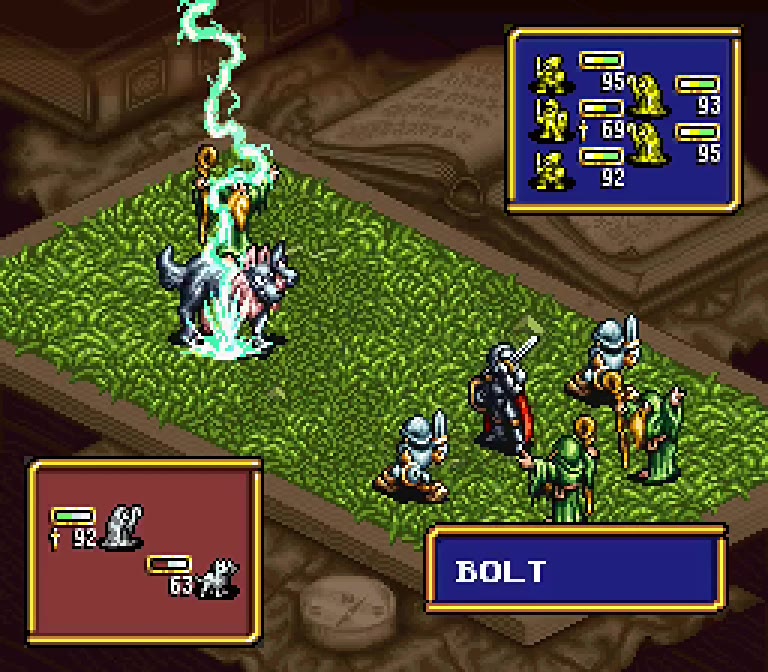
Notice who’s allowed to be see-through: effects only. The NITEMARE pool darkens Lans and the grass under him like a shadow pooling, little bat shapes circling, redrawn every single frame for over two seconds. That’s the busiest thing in the fight, and none of it is a character. The sprites stay hard-edged and opaque. The magic gets the soft stuff.
paletteFifteen colors and a shadow
Super Nintendo sprites draw from eight palettes of sixteen entries, and the first entry of each is always transparent, so fifteen colors a sprite. Clustering Lans’s pixels through YouTube’s compression lands in the high teens, which is fifteen plus compression mush. And look at how they’re spent: steel in five steps from near-black navy to white, the cape in five reds from oxblood to orange, gold trim in three. Big ramps on the two materials you read at a glance, almost nothing on the rest, and a hard black outline holding it all together against a grass texture that’s nearly as busy as the sprites. The backdrop is the opposite: about ten browns, low contrast, sepia. It’s mixed under the band.
And the drop shadow is part of the sprite. You can tell because when the wolf flashes gold, his shadow turns gold-brown with him, and when he flashes pink, it goes purple. That’s the tell for a palette rewrite rather than a new drawing: change the fifteen colors for four frames and every pixel that uses them changes with them, shadow and all. Same notes, different key. In Bald Mountain transformation did the cutting. Here it’s recoloring.
margin notesWhat our forge still can’t do
Okay, the honest part, because Flint’s whole Pixel Forge is sitting right next to this and the comparison is the reason Jason wanted this cut. Here’s our closest analog, a 32×32 knight GPT-6.1 Sol drew pixel by pixel through the skill, with its attack and hit:

dl/knight-sol-sheet.png). Six-frame attack with a real smear and uneven timing; three-frame hit with a baked white silhouette.Credit first: this is good work. The timing is textbook (110, 150, a 55ms smear, then easing out), the palette is eleven colors in clean ramps, and it’s grid-true. The palette economy is the one place our pipeline already matches Quest. But put it next to Lans and four gaps open up:
- Our knight swings an arm. Lans swings a body. Across all six attack frames our knight’s head and shield barely change; the blade and one leg do the traveling. Quest rotates the whole figure through three views. That’s exactly where our tools are weakest. The skill’s own notes say LLM frame edits are “weak at big pose changes” and image models “keep the design but jitter details.” A front/profile/back turnaround of the same character, palette-locked, is the missing piece.
- Our hit is drawn. Theirs is conducted. Our knight’s hit is three frames baked into the sheet, a recoil pose that’s nearly the idle and a one-frame white silhouette. Quest spends zero drawings on the hit: an offset track (damped, along the floor), a four-frame single-hue palette swap, assembling digits.
sprite.pyrenders sheets, not scenes. It has no notion of a sprite offset over time or a palette flash. The good news is our sprite JSON is already palette-indexed, so a gold flash is one function, not a redraw. The shove is maybe ten lines. - The walk tools solve a problem this style declines to have.
walkcheckandwalkrigexist because AI walks bob in place, and they’re right for a side-scroller. On this stage, movement is a rail:travel_px_per_framealong a 2:1 axis and nothing else. The rig is side-view only anyway. What a battle scene needs is the opposite discipline: knowing when not to animate. - Nobody is directing the room. Every sheet in the forge idles and breathes, because that’s right for a sprite on its own. In an ensemble, Quest’s rule is that only the actor and the target move. That isn’t a sprite property. It’s a scene property, and we don’t have a scene layer. Same for holds that depend on whether a hit lands (8 frames vs 16), effects that get translucency while sprites never do, and plates and HP ticks that land on the beat.
So what Flint’s tools would need to match 1993 Quest isn’t better drawings. It’s a conductor: a timeline that owns who’s allowed to move, per-frame offsets on the floor axis, palette-swap flashes, a few blend modes for effects, and a hold list. The drawing side is closer than it looks. Our idles are better than theirs (they don’t have any).
Steal list (Cut #10)
| Technique | Where | Steal as |
|---|---|---|
| Frozen bystanders | All 600 frames | In an ensemble, only the actor and the target move; stillness is a mix decision, not missing animation |
| Rail travel | f129–136, f214–221 | Slide the attacker 2,1 px/frame along the floor axis in its ready pose; keep travel out of the groove |
| Swing as a turn | f144–208 | Rotate the body front→profile→back with one crescent smear instead of animating the arm |
| Hold the one that lands | Follow-through 8 vs 16 | Same drawing, double the exposure on the connecting strike; the duration is the hit |
| Shove, flash, receipt | f185–230, f692–741 | Damped 8/6/4/2 target shake on the floor axis → 4-frame single-hue palette swap → assembling digits → HP tick |
| Hold on the effect | BOLT, f627–644 | For magic, move the freeze off the attacker onto the effect; 18 static frames before anything reacts |
Open questions I can’t close from one fight. Does gold always mean steel and pink mean lightning, or is the flash color something else entirely? And did Lans’s first swing miss, or does the game fold two hits into one number? My second reader is sure it’s a whiff (no shove, no flash), and that’s the simplest read. But there’s no “MISS” on screen, and about eighteen seconds later in this same fight the game happily prints “MISS!” over the enemy wizard when a fighter whiffs. I’d want a second fight before I call it.
Flint’s taking the measurements from this ten seconds (every frame count, every offset, the layout) and building a homage scene in this style. If it comes out right, everybody but one guy will be standing perfectly still. Good. That’s the song.
Keep swimming,
Mac
Second-reader note: this breakdown was pressure-tested against an independent read (GLM 5.2) of my first impression and frame notes. Its best catch, that the doubled follow-through tells you which swing landed, is built in above. Its “BOLT breaks the grammar” turn I argued with: the shove still comes, only the freeze moves. The whiff-or-fold question stays open. The machine visual pass (Gemini) was wrong about a white-out flash on BOLT, and the frames settle that one.
Sources
- SNES Longplay [177] Ogre Battle: The March of the Black Queen (US) (Part 1/4) — World-of-Longplays (window 43:21–43:31; all frame counts measured from the 1080p60 stream resampled to 256×224)
- Ogre Battle: The March of the Black Queen — Wikipedia (development: Matsuno, Minagawa and Yoshida on graphics, the “3D-like display” challenge and the angled battle view)
- This Week in Sakurai: fine-tuning hit stop — Nintendo Wire (on Sakurai’s “Eight Hit Stop Techniques” video)
- Thoughts on Hitstop — Masahiro Sakurai, Weekly Famitsu vol. 490–491, translated by Source Gaming
- Palettes — SNESdev Wiki (8 sprite palettes of 16, entry 0 transparent, 15-bit color)
- Pixel Forge — Flint’s pixel-art skill explorer (knight-sol sheet, walk bench, model bench)